






 How To Invest
 Stocks
 Mutual Fund
 Knowledge
 Mar 06,2026
 1354
1354
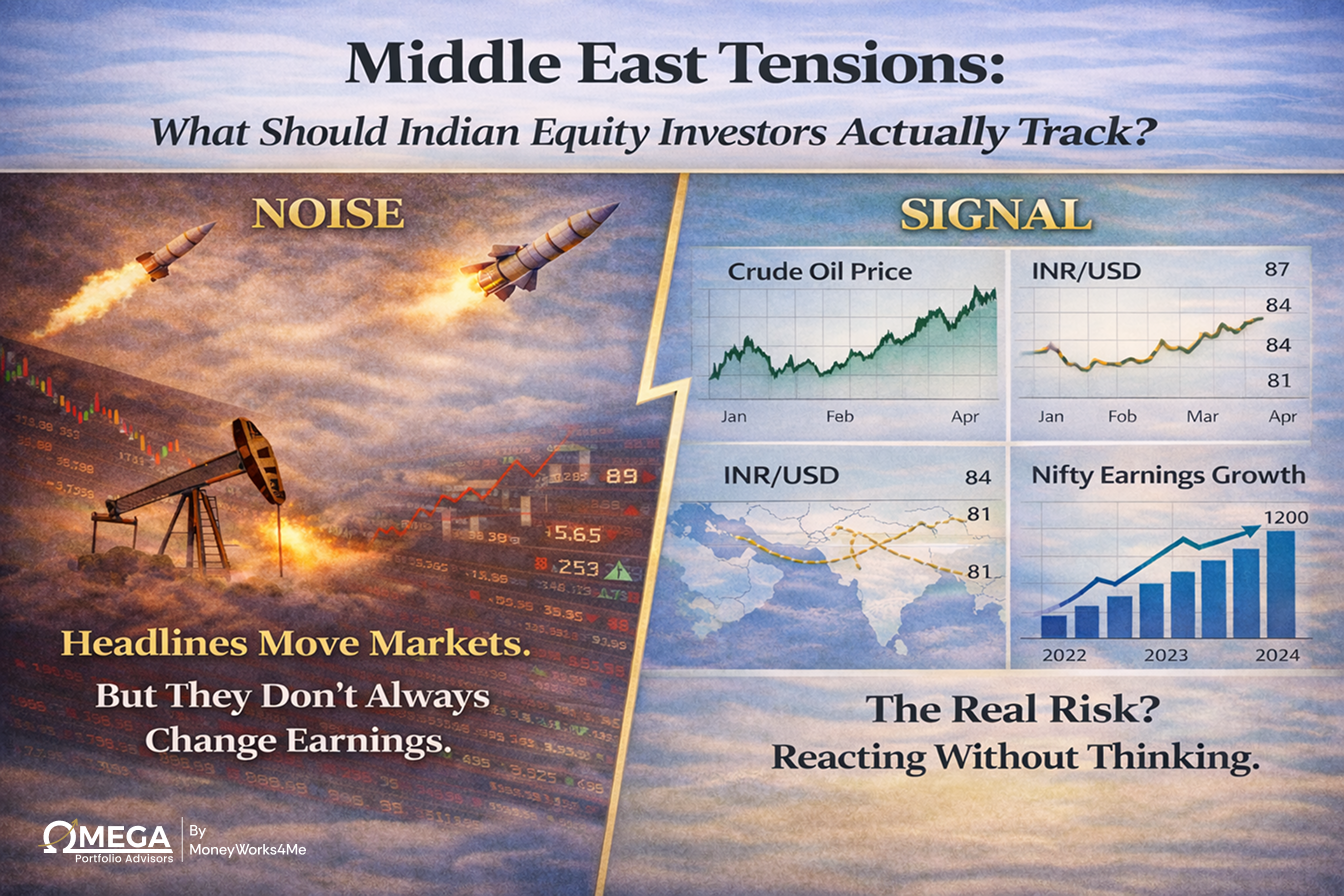


With escalating tensions involving Israel, the United States and Iran, markets are reacting in predictable ways. Oil prices are moving higher, currencies are volatile, reflecting shifts in global risk sentiment. News flow is intense and often dramatic. Yet for Indian equity investors, the real question is not what happened yesterday. The more relevant question is how these developments affect portfolio outcomes and what one should be doing in this scenario.
In the short term, markets have already corrected. Could they correct further? That remains possible, particularly if the conflict extends for several weeks. The precise duration of geopolitical events is inherently uncertain. However, the more important issue for investors is not the timeline of the conflict but how one can make better investing decisions and for that understanding how it will affect India’s economy and corporate earnings?
Oil and Energy Prices: The First hit
India imports nearly 88-89% of its crude oil requirements, and nearly 50% from Middle East alone. This makes energy prices a significant macroeconomic variable. A sustained rise in crude prices can widen the current account deficit, increase inflationary pressures and compress corporate margins, especially in energy-intensive industries.
The critical factor, however, is duration rather than intensity. Temporary spikes are often absorbed through inventory management, partial price hikes and fiscal adjustments. A prolonged supply disruption, on the other hand, can alter assumptions around inflation, growth and earnings forecasts.
For equity investors, the essential question is whether higher oil prices represent a short-term geopolitical situation or a structural supply shock. If the spike proves temporary, earnings impact is limited and markets stabilise. If it becomes structural, earnings revisions follow and valuations adjust accordingly. Eventually, oil prices are likely to return to their long-term trend, allowing the Indian economy to move toward its growth goal.
Currency Movements and Capital Flows
Geopolitical uncertainty usually triggers a global risk-off response. Capital flows toward perceived safe havens, strengthening the US dollar and exerting pressure on emerging market currencies. The Indian rupee often reflects this adjustment quickly.
A moderate rupee depreciation can support export-oriented sectors like IT services and pharmaceuticals because their overseas earnings translate into higher rupee revenues. However, if foreign investors continue pulling money out of Indian markets, liquidity can tighten and stock market valuations may come under pressure.
Currency movements often react faster than economic data. For investors, the key question is whether these changes meaningfully affect company earnings.
Inflation and Policy Implications
Retail inflation in India remains relatively contained at present and within the 4% target set by the Reserve Bank of India. This means that even a 1–1.5% rise in inflation is unlikely to be viewed negatively by either the market or the RBI. The key question is whether other factors push inflation much higher than this level, which could become counterproductive for the broader economy. In such a case, higher prices can reduce household purchasing power, force interest rates higher, and create pressure on the currency. Over time, this can slow consumption, investment and overall economic growth.
Markets can usually absorb short bursts of inflation. What tends to affect valuations is persistent inflationary pressure that begins to impact economic growth and corporate profit margins.
So the question becomes: How vulnerable is India to this shock?
India enters this phase with some visible buffers. Foreign exchange reserves remain healthy, the current account deficit is manageable at roughly 1% of GDP, and domestic demand continues to act as a stabilising force.
At the same time, dependence on imported Crude Oil remains a structural vulnerability. Markets can digest volatility driven by sentiment, but a sustained deterioration in external balances or corporate earnings is what truly tests economic resilience.
Portfolio Construction: The Real Shock Absorber
In periods of geopolitical stress, portfolio construction matters far more than prediction. Markets may react sharply to headlines, but the real question for investors is whether their portfolio is built to withstand temporary shocks without forcing emotional decisions.
A resilient portfolio should be able to absorb volatility without causing the investor to lose sleep. When portfolios are overly concentrated in a few sectors, themes, or momentum-driven stocks, even moderate market corrections can feel severe. This often triggers panic selling, not because the underlying businesses are weak, but because the portfolio lacks structural balance.
The objective is not to eliminate volatility, that is impossible in equity investing. The objective is to ensure that temporary shocks do not translate into permanent damage or emotional decision-making.
This leads to an important question investors should ask themselves: What is the biggest risk to your portfolio? Your own behaviour.
In many cases, investors damage their own portfolios when volatility rises. Selling fundamentally strong businesses during corrections, reacting to headlines, or abandoning discipline because of temporary market movements can convert normal price declines into permanent capital loss.
The foundation of resilience lies in owning high-quality, fundamentally strong companies. Industry leaders with efficient operations, durable competitive advantages, and strong balance sheets tend to experience smaller drawdowns during periods of uncertainty. Even when they correct, they typically recover faster because their earnings power remains intact. Markets may temporarily reprice these businesses, but their ability to generate cash flows and maintain profitability helps them rebound sooner than weaker peers.
Diversification also plays a crucial role. A well-constructed portfolio should not be overly dependent on a single sector, economic driver, or macro variable. When portfolios are diversified across industries, revenue drivers, and business models, geopolitical events or economic downturns are less likely to impact every holding simultaneously. This reduces the probability that the entire portfolio declines sharply at the same time. Portfolios built around earnings strength, balance sheet discipline, and sensible diversification tend to experience volatility without long-term impairment.
In uncertain environments, resilience is not created during the crisis. It is designed into the portfolio long before the volatility begins.
Resilience in portfolios becomes even more important when viewed through the lens of history. Markets have repeatedly shown that geopolitical or economic shocks tend to trigger sharp reactions initially, but the lasting impact is often far less severe than feared. During the Russia–Ukraine War, global markets corrected as energy prices surged and uncertainty rose, and Indian equities also declined before stabilising within months as earnings and domestic demand trends remained intact. The pattern across such episodes is consistent: sentiment reacts quickly, while fundamentals reassert themselves over time. If current tensions remain regionally contained and do not trigger wider global disruptions, markets are likely to follow a similar path as clarity returns and earnings visibility improves.
The Bigger Investing Lesson
For most investors, the greater risk is behavioural rather than geopolitical. Emotional reactions to volatility, selling strong businesses during corrections or abandoning asset allocation discipline can turn temporary declines into permanent losses.
When earnings remain resilient and balance sheets are strong, volatility is simply part of the investment process. Markets have repeatedly shown that initial reactions to geopolitical stress are rarely the final outcome.
Volatility is inevitable. What matters is avoiding decisions that permanently impair long-term wealth. This becomes far easier when the portfolio is constructed well.
Written by
Shaili Lele & Rutuja Patil

Already have an account? Log in
Want complete access
to this story?
Register Now For Free!
Also get more expert insights, QVPT ratings of 3500+ stocks, Stocks
Screener and much more on Registering.



Comment Your Thoughts: